
37% Lighter Trolley Cart for FleetPride — Validated in Ansys
FleetPride's axle trolley cart redesigned in Ansys — 37% lighter (210 lbs → 132 lbs) while maintaining full 1,000 lb rated capacity.


For conventional AEC ‘D’ or ‘E’-size sheets:
This is a great add-on sale, earning free money with almost no work. We take all liability. Quantity discounts available.

The client is yours, not CAD / CAM Services. In general, we bill you, not the client. And unless something is needed, we never contact the client. We are also happy to support and use any customer templates, drafting standards, specific blocks/cells, layers/colors/fonts, etc. as needed at no cost. Our goal is to give the client a file they do not have to touch. Our work is exactly the same as what they produce in-house. 3D work fees can vary widely. We are happy to provide a quote, but we need to review the project scope and sample files before we can bid. Again, you will get wholesale rates for this. All CAD work is version-specific, so please specify the desired CAD version. We converted over 1,000,000 3D CAD files for Amazon.com alone. So, we know we can provide a great product for your clients.AS 9100, CMMC Level II, 800-171 compliant, and ITAR registered.

We have SME’s (Subject Matter Experts) on most of these CAD systems.
and we ONLY deliver one file type –
CAD Perfect CAD Conversions™.
Give us a try; you will be glad you did.
For any questions, please call 1-800-SCAN (7226), or 972-978-4288 (Dallas),
or email IRGA@cadcam.org
or
FleetPride's axle trolley cart redesigned in Ansys — 37% lighter (210 lbs → 132 lbs) while maintaining full 1,000 lb rated capacity.

FleetPride's axle trolley cart redesigned in Ansys — 37% lighter (210 lbs → 132 lbs) while maintaining full 1,000 lb rated capacity.
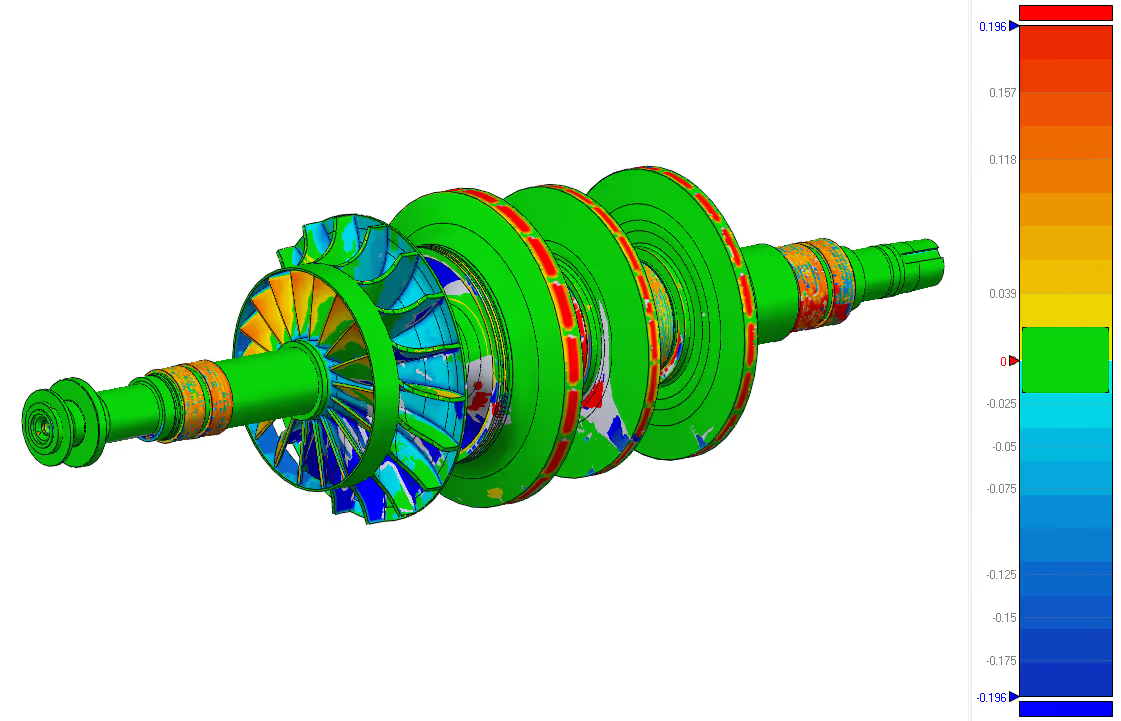
A client needed a replacement rotor shaft for industrial equipment. Original CAD files, drawings, and specifications were unavailable.
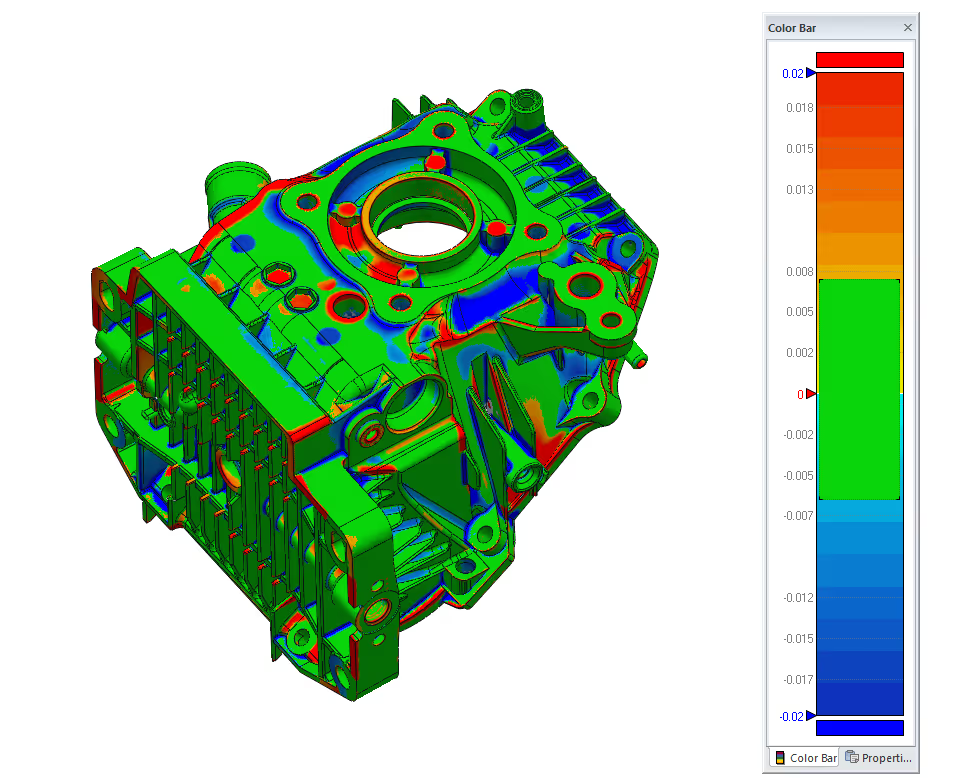
In this case study, we aimed to create a full digital model of an engine casing. This casing had no current CAD files, outdated drawings, and undocumented shapes because of years of use and part changes.

We were recently tasked with recreating a fan housing using only the client’s original paper drawings.
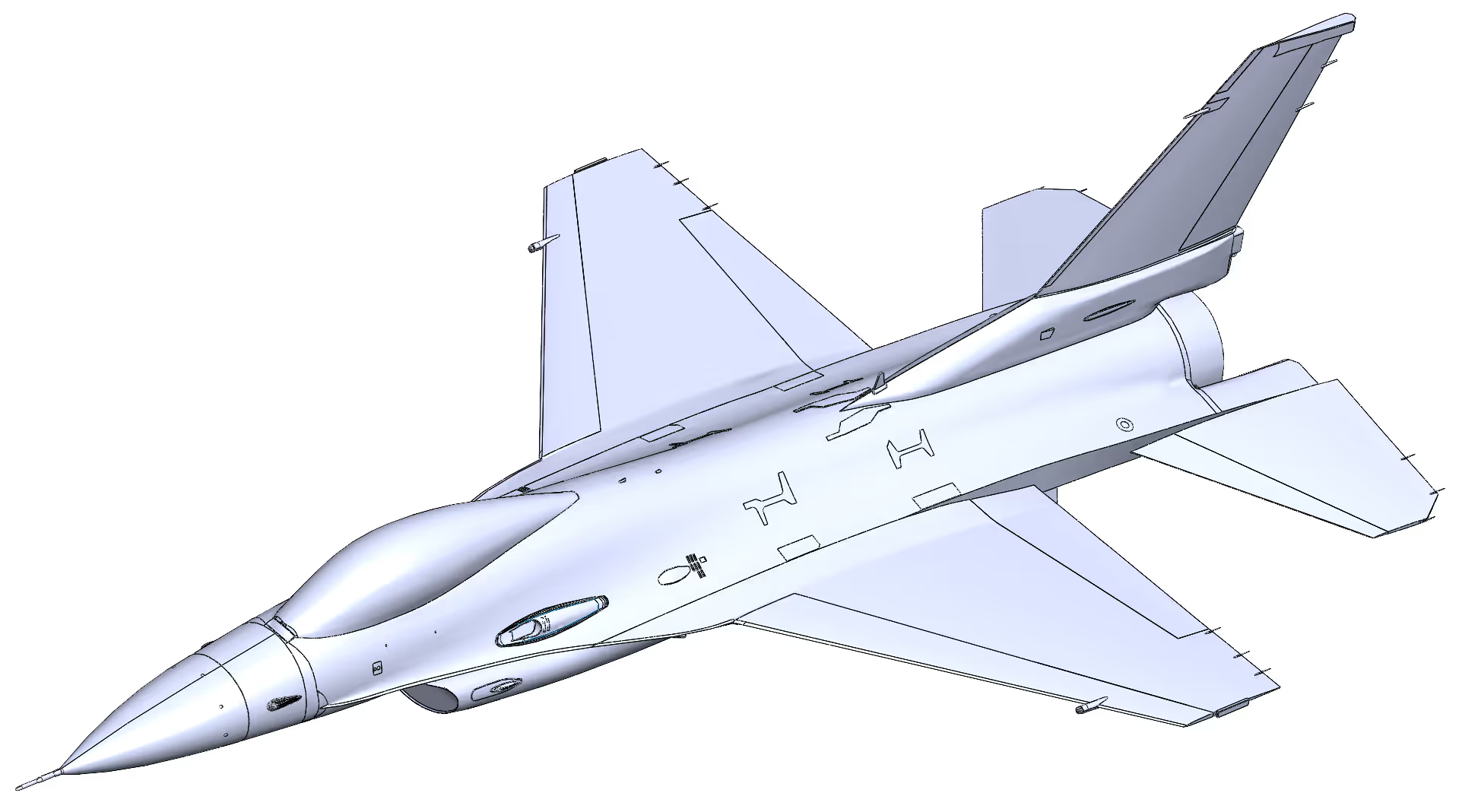
This case study describes how we helped a defense customer turn a dense point cloud into a usable surface model. This model was a CAD surface for an F‑16 that could feed straight into simulation.
On behalf of JJET Enterprises, I just wanted to thank you and Cad / Cam Services again for the great job and quick turn-around time on the job that we sent you. We would recommend you and definitely will be doing business with you in the near future.
James R. Thomas
JJET Enterprises
On behalf of JJET Enterprises, I just wanted to thank you and Cad / Cam Services again for the great job and quick turn-around time on the job that we sent you. We would recommend you and definitely will be doing business with you in the near future.
James R. Thomas
JJET Enterprises
On behalf of JJET Enterprises, I just wanted to thank you and Cad / Cam Services again for the great job and quick turn-around time on the job that we sent you. We would recommend you and definitely will be doing business with you in the near future.
James R. Thomas
JJET Enterprises
.svg)

On behalf of JJET Enterprises, I just wanted to thank you and Cad / Cam Services again for the great job and quick turn-around time on the job that we sent you. We would recommend you and definitely will be doing business with you in the near future.
James R. Thomas
JJET Enterprises
“You ROCK and a huge thank you to you and your team for working so diligently to hit our goals.”

Greta Nintzel
Content & Digital Media Associate, Rich Media Team (amazon supply)
Thank you so much for all of your help.
It is greatly appreciated.

Angie
CTR USARMY CCDC ARL (USA)
“CAD / CAM Services has been our source for all CAD related projects over the past 10 years. If it involves CAD conversion or large format scanning, CAD / CAM SERVICES is always our first call.”
Bill Johnson Jr.
Dallas Aerial Surveyors
“CAD / CAM Services provided timely professional consulting advice and guidance that greatly helped us configure our platform for current and near-future expansion needs. Many thanks to Scott Shuppert for all his hard work on this project.”

Richard Schmitter
GTE Media Ventures
“We used CAD / CAM Services for CAD conversion work and it was great! We have already decided to use them for our next project. They did everything they said they were going to do and more. The work turned out well.”

Pete Iannuzzi
Sony Music
“You have been absolutely the BEST Company to work with in my entire career. I almost hate to see us finish our Mylars!”

Jerry McNabb
R Civ USAF – Tinkers Air Force Base
“We used CAD / CAM Services for scanning and converting film and also the purchase and install of IMR’s Electronic Document Imaging Product – Alchemy. They know what they are doing and it has turned out to be a smart purchase for us. We will be adding additional licenses of this product, along with additional scanning and conversion services from them.”

Bill Scott
City of Carrollton
“CAD / CAM Services scanned > 6,000 maps for us and sold and installed a scanner and an EDMS system to our district. It has turned out to be a great investment for our district. We had several competitive firms compete on cost and scanning quality. CAD / CAM Services was the hands-down winner for myself, the engineering staff and the board. We are presently publishing the images on the internet and plan to continue using CAD / CAM Services They treated us fairly and delivered on-time and on-budget.”

Bo Daffin, CTA, RPA
Deputy Chief Appraiser of Central Appraisal District of Collin County
“RISD has been using CAD / CAM Services for years and has no need to consider anybody else. We have used them for scanning thousands of drawings and the install of our engineering/facilities management EDMS system.”

Greg Schulz
Richardson Independent School District
“CAD / CAM Services converted our plant drawings into AutoCAD and they turned out well. We will use them again.”

Phillip Schmidt, Jr.
District Plant Engineering Manager, UPS
“We purchased several Cyco’s AutoManager Workflow licenses from CAD / CAM Services and it has worked out well. We intend to add to this as budget allows”.

Nathan Jones
City of Garland Texas, Engineering Department
“Overall it looked really nice. I definitely like your approach of doing the internals 1st. It really gives me a better idea of what I’m actually programming.”

Shane Duncan
Engineering Manager – W Machine Works Inc.
“CAD / CAM Services was so easy to work with. They delivered our project on time and on budget. I highly recommend.”
Nikko Meyers
Scan Direct
“CAD / CAM Services digitized and converted Electric Utility maps to AutoCAD for our firm. We have been very pleased with the quality of their work and have found CAD / CAM Services to be cooperative and easy to work with.”

Ed Turk
V.P. Cornelius – Pierce Consulting Engineers
“CAD / CAM Services provided timely professional consulting advice and guidance that greatly helped us configure our platform for current and near-future expansion needs. Many thanks to Scott Shuppert for all his hard work on this project.”

Chris Kidd
Dilon Technologies
.jpg)
.avif)
.png)
Our 3D laser scanning services capture precise surface geometry using high-resolution scan data. Laser scanning is ideal for reverse engineering, inspection, as-built documentation, digitization of legacy parts, and large-scale industrial scanning projects.
CAD/CAM Services provides professional 3D scanning services for parts, assemblies, tooling, aircraft components, facilities, and industrial equipment. Our scanning process captures accurate physical geometry and converts it into usable digital data for CAD modeling, inspection, documentation, and manufacturing support.
Scan-to-CAD services convert physical parts or scanned point cloud data into accurate 3D CAD models. CAD/CAM Services creates native CAD deliverables in CATIA, Siemens NX, Creo, SolidWorks, Inventor, STEP, IGES, and other required engineering formats.
For conventional AEC ‘D’ or ‘E’-size sheets:
This is a great add-on sale, earning free money with almost no work. We take all liability. Quantity discounts available.
The client is yours, not CAD / CAM Services. In general, we bill you, not the client. And unless something is needed, we never contact the client. We are also happy to support and use any customer templates, drafting standards, specific blocks/cells, layers/colors/fonts, etc. as needed at no cost. Our goal is to give the client a file they do not have to touch. Our work is exactly the same as what they produce in-house. 3D work fees can vary widely. We are happy to provide a quote, but we need to review the project scope and sample files before we can bid. Again, you will get wholesale rates for this. All CAD work is version-specific, so please specify the desired CAD version. We converted over 1,000,000 3D CAD files for Amazon.com alone. So, we know we can provide a great product for your clients.AS 9100, CMMC Level II, 800-171 compliant, and ITAR registered.
We have SME’s (Subject Matter Experts) on most of these CAD systems.
and we ONLY deliver one file type –
CAD Perfect CAD Conversions™.
Give us a try; you will be glad you did.
For any questions, please call 1-800-SCAN (7226), or 972-978-4288 (Dallas),
or email IRGA@cadcam.org
or
The typical AEC D & E size sheet is $225. There are possible discounts depending on the job size. The more you convert the less you pay. The bulk of the files we produce are for AutoCAD.
In order to make an accurate representation, you have to calibrate the original drawing, which may have deformed during its storage period. Non-dimensioned mediums need to be thoroughly calibrated before digitizing.
Parts of scanned data may be lost due to time and other factors. Because it is important to recreate the design intent, we need to recreate lost data.
You ONLY receive Cad Perfect™ files – as if you had drawn these by hand.
Using Revit, yes we do. Think of BIM as an intelligent 3D model of your building. We know exactly where all of the HVAC is, IT cabling, electrical, the cost of doors and windows, when mechanical systems need to be serviced, all the way to a room number with a phone number and IP in that room. In addition to our Ray Tracing technology to support some very life-like photo renderings.
The Department of Homeland Security protocol PPD-21 requirement has deemed that sixteen (16) industries and services are critical to our US Nations security.
These industries require additional security protocols when creating CAD files. CAD / CAM Services follows all of these requirements. Think of industries and info structures such as power, water, along with fourteen (14) other industries. For a full list please see Critical Infrastructure Products.
Mylar films can be stored in climate-controlled facilities. However, films get skewed and change sizes over time – ironically not linear. So what changes on one end, does not apply to what is in the middle, or the other end. We have seen ‘J’ size Aerospace Mylars (about 48×180”), vary by a full inch.
CAD/CAM Services utilizes a proprietary process to make Mylar raster images dead on a 5” or 10” grid. Our process was developed in conjunction with, and approved by Boeing engineers.
It depends on the complexity of the scanned model and material properties. As, for example, it may be much more complicated to properly scan an object with a reflective surface, than a non-reflective surface. It also depends on three main factors:
Simple quick cell phone photos are worth a thousand words to us. To know for sure you can request a quote. It is of course, free – and treated as if an NDA is already in place.
Some averages:
Because so much of our business is Aerospace related, our scanning – and the completed CAD file HAS to be within ±.005” anywhere on that part, we never use consumer-grade scanners. The scanners we use start at $25,000 and go up to $700,000 (CT) per scanner.
At any given time, we have in excess of $ 5 million just in scanning hardware we use. In addition, a hidden factor of scanning on any system is the assembly and clean up of any scan. The rule of thumb is a 2-1 ratio. So even with our experienced scanning staff, if we spend one-hour scanning; we will then spend an additional two hours of clean up and assembly before our CAD group gets the Point Cloud file to simulate or reverse engineer.
A point cloud is thousands if not millions of data points located in space by X, Y, Z coordinates. Images of this nature are often captured with Faro Focus or Artec scanners that specialize in large-area scanning. Most likely you obtain building and territory plans in this file format.
A polygon mesh is a set of triangles located in the same manner. These scans are obtained with Artec, Creaform, Enscan and other handheld scanners. Parts and reverse engineering device scans are usually polygon meshes.
The scanners we use are as accurate as the industry offers – from anybody at any cost. We use Faro and Artec 3D scanners, in addition to Faro CMM type arms, including the Surveyor tables. Depending on what scanner we use:
Fill out our quote form, attach your files, or simply send us an email. Tell everything about your project, like the model purpose.
For smaller files < 15 MB you can simply email them to us. For something larger, just drop them in any number of drop boxes like Dropbox, Google Drive, Microsoft OneDrive and others. Or if you would like, just contact us for a private, hardened link.
It is fine to use most any time of compression such as *.zip, *.rar, *.tar, *.7z, *.arc, *.LBR, and even *.iso images.
A direct email is sales@cadcam.org
We also use a hardened OwnCloud web file sharing platform for unlimited file transfers. We provide unique and very private Web Storage Portals, this also supports file syncing for extreme convenience for you. Because so much of our work is DOD or weapons design work, Security – and confidentiality is very important to us.
Yes. NDAs are a common part of our business. All data is yours – not ours, and treated as proprietary data and not for public consumption or use. Probably 70% of our work is under NDA agreements. We can generally get these signed within the day.
It depends on the scope of work:
Simple jobs have a lead time of 48 hours. Larger projects are delivered and invoiced weekly.
Yes, we did back in 2008. We started using Cad Perfect™ back in the early 1990s because all of our customers wanted only real Cad Perfect™ work. Back then the buzz words were terms like machine ready, or DXF Traceover and others.
The problem is, nobody wanted that. They all wanted drawings and models that they did not have to touch. Everybody wanted drawings just as if they hand redrew the work themselves.
Thus, Cad / Cam Services™ was the first company to start offering ONLY Cad Perfect™ work.
Yes we do, and have now for several years. In addition, we also support the industry specific plans as well.
.svg)
